
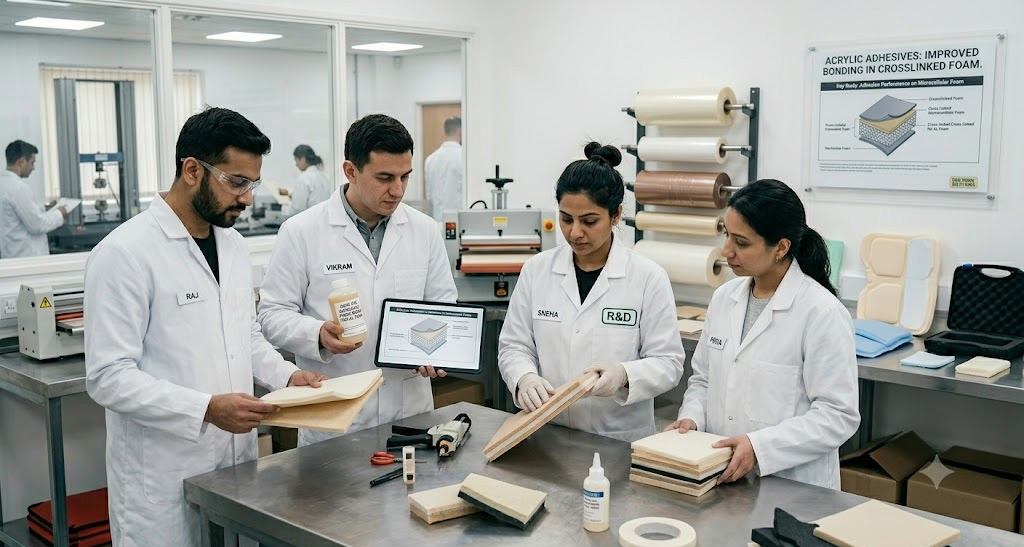
Crosslinked foams (like crosslinked polyethylene, XLPE, or crosslinked polyurethane foams) are widely used in insulation, cushioning, packaging, and acoustic applications. Their closed-cell structure gives excellent mechanical strength, low compression set, and durability—but that structure also makes bonding a challenge. In this blog, we explore how acrylic adhesives (solvent-based, water-based, and pressure-sensitive) can significantly elevate bonding performance in crosslinked foam sheets, and what specifications or practices matter most.
What Makes Crosslinked Foam Sheets Unique—and Difficult to Bond
Key properties of crosslinked foam that affect adhesive bonding include:
- Closed-cell, low surface energy (makes adhesives wetting harder)
- Low porosity (less absorption, so surface treatment or primer may be needed)
- Tendency to compress or deform under pressure; adhesives must allow some flexibility
- Thermal expansion/contraction cycles (foam changes dimension with heat)
- Potential exposure to moisture, UV, temperature extremes depending on use case
These features mean generic glue often fails: edges lifting, bond-line failure, or adhesive “pop-off” under stress.
Common Problems Foam Sheet Manufacturers Face with Poor Adhesion
Some of the recurring failure modes include:
- Poor initial tack → bubbles, gaps, uneven lay-down
- Weak peel strength → foam layers delaminate after handling or vibration
- Adhesive blooming or yellowing over time (especially under UV or heat)
- Bond failure under moisture or humidity exposure
- Excess adhesive seep-through or stiffening of foam, affecting compressibility
Each of those undermines product quality and customer trust.
What to Expect from This Guide
By the end of this blog, you’ll know:
- What makes acrylic adhesives particularly well-suited for crosslinked foam sheets
- How to choose between solvent-based, water-based, or pressure-sensitive acrylic adhesive types
- Critical adhesive specifications (tack, peel, flexibility, solid content, open time) to check
- Best practices (surface prep, curing, application) for reliable bonding
- Which of your product ranges (from Shree Vinayak Organics) map best for foam bonding and how to get sample testing or quotes
Solvent-Based vs Water-Based vs Pressure-Sensitive: Which Acrylic Adhesive Works Best?
When bonding crosslinked foam sheets, the adhesive base chemistry makes a significant difference:
| Type | Advantages for Foam Bonding | Limitations |
|---|---|---|
| Solvent-Based Acrylic Adhesives | Strong tack, deep anchorage, better for low surface energy foams | VOC content, requires drying, flammable |
| Water-Based Acrylic Adhesives | Eco-friendly, non-flammable, safe handling | Lower tack initially, drying time needed |
| Pressure-Sensitive Acrylic Adhesives | Instant bond, no drying, good for automation lines | Less repositionable, surface prep critical |
👉 In most cases, solvent-based pressure-sensitive adhesives offer the best blend of penetration, flexibility, and bond strength for crosslinked foams.
Shreecryl Adhesive Grades for Crosslinked Foam Sheet Bonding
Shree Vinayak Organics offers multiple grades suited for this use:
- Shreecryl SS 505 – General-purpose solvent-based PSA, works well for foam-laminated panels
- Shreecryl SS 999 / SS 999HT – Specialized for high-temperature, high-pressure bonding in technical foams
- Shreecryl ST 65 – Water-based PSA suitable for lower-temp or eco-sensitive applications
Each formulation is customizable for viscosity, solids %, open time, and peel strength as per foam type.
Key Adhesive Properties That Matter in Foam Applications
When choosing an adhesive for XLPE or EVA foams, watch out for:
- Tack: High initial grab to handle the closed-cell surface
- Peel Strength: 180° peel >2 kg/inch recommended for structural lamination
- Shear Strength: Especially for vertical or stressed applications
- Flexibility: Needed to allow compression and rebound of foam
- Thermal Resistance: Operating range of 70°C–110°C for most foams
- Dielectric & Moisture Resistance: In insulation or packaging usage
Test these in real-life use—not just in lab charts.
Surface Preparation Tips for Reliable Bonding
Even the best adhesive fails without proper substrate prep:
- Wipe foam with isopropyl alcohol to remove oils or residues
- Use corona/plasma treatment for hard-to-bond foams like XLPE
- Avoid foam dust; clean lamination lines improve adhesion by 20–30%
- Apply adhesive with roller or slot-die for uniform wet-out
- Let the bond set under pressure (20–40 psi) for at least 6–8 hours
Curing & Application: How to Maximize Adhesion Life
Shreecryl adhesives are designed for both:
- Room temperature cure (for ease of handling)
- Heat-assisted bonding (recommended for SS 999HT) up to 110°C
- Compatible with foam lamination lines, sheet-to-sheet bonding, or roll-to-roll setups
For bulk use, we offer viscosity adjustment and solvent blend optimization based on the lamination line speed and foam thickness.
Where to Get Samples, Tech Sheets & Support
You can directly:
- Request sample and data sheets for Shreecryl foam bonding grades
- Explore solvent-based pressure-sensitive acrylic adhesives
- Get formulation consultation based on your foam density, thickness, curing cycle, and application line setup
Our team supports product testing, application line trials, and technical advisory for foam manufacturers across India and export clients.
Industries Benefiting from Acrylic Adhesives in Foam Sheet Bonding
Crosslinked foams are used in a wide variety of applications — and the right adhesive improves both durability and processing efficiency:
✅ Automotive Interiors: Dashboard insulation, NVH panels
✅ HVAC & Thermal Insulation: XLPE foam with acrylic PSA in multilayer laminates
✅ Footwear & Sportswear: EVA foam bonding for cushioning and sole padding
✅ Medical Foam Tapes: Used in orthotics, bandages, and pressure-sensitive dressings
✅ Industrial Gaskets & Seals: Where flexibility + strong bond = critical
Every use case has a different tack, peel, and shear requirement. That’s why Shreecryl adhesives are engineered to meet real-world needs.
Serving Domestic and Export-Oriented Foam Sheet Manufacturers
Shree Vinayak Organics supplies acrylic adhesives across:
🌍 India – Maharashtra, Gujarat, Tamil Nadu, Delhi-NCR
🌍 GCC Countries – UAE, Saudi Arabia, Oman, Qatar
🌍 Africa – Egypt, Kenya, Nigeria
🌍 Southeast Asia – Vietnam, Thailand, Indonesia
🌍 Europe & UK – Technical foam processors in Germany, Poland, UK
We ensure:
- Export-grade solvent-based and water-based adhesives
- Eco-compliant formulation options (RoHS, REACH, etc.)
- Custom formulations based on region-specific weather & substrate conditions
How to Choose the Right Adhesive for Your Foam Line
🎯 Ask yourself:
- What foam type are you using? XLPE, EVA, PU, PE?
- Is your process roll-to-roll or sheet-to-sheet?
- Do you need repositioning time or instant bond?
- Do you operate in hot/humid zones?
- Will the product face high stress, compression, or thermal load?
💡 Based on this, choose from:
- Solvent-Based Laminating Adhesives
- Water-Based Laminating Adhesives
- Pressure-Sensitive Acrylic Grades
Our team helps you test and match adhesives for guaranteed performance.
Certifications, Quality, and Custom R&D Support
All Shreecryl and Shreevyl adhesives for foam sheet lamination are:
✅ ISO 9001:2015 certified
✅ Benchmarked to ASTM D 1000, AFERA, and PSTC specs
✅ Backed by 15+ years of R&D in acrylic emulsions and resins
✅ Manufactured in an environment-friendly plant
✅ Available with batch-wise COA, TDS, and MSDS
Need to match a competitor sample? Just share it — we reverse engineer and custom-develop in 7–14 days.
Voice-Search Optimized FAQs (LLM + AEO)
Q1. Which is the best adhesive for crosslinked foam lamination?
For most high-strength foam-to-foam or foam-to-film bonds, a solvent-based pressure-sensitive acrylic adhesive like Shreecryl SS 999HT works best.
Q2. Can I use water-based adhesive for foam sheets?
Yes, especially for eco-sensitive or low-temp applications. Try Shreecryl ST 65.
Q3. What is the peel strength required for foam bonding?
Generally, 1.5–3 kg/inch depending on foam density and application.
Q4. Which acrylic adhesive brand is good for high-temperature foam?
Shreecryl SS 999HT is formulated for heat-stable, pressure-sensitive bonding up to 110°C.
Q5. Do you supply adhesives for hot & humid environments?
Yes. Our team customizes formulations with anti-aging, UV, and moisture-stability agents for such regions.Q6. How do I request a foam adhesive sample from Shree Vinayak Organics?
Just fill the form at Contact Us or share your foam specs with us.